Why Doesn’t Lucky FIP Develop 30mg/ml Injections?
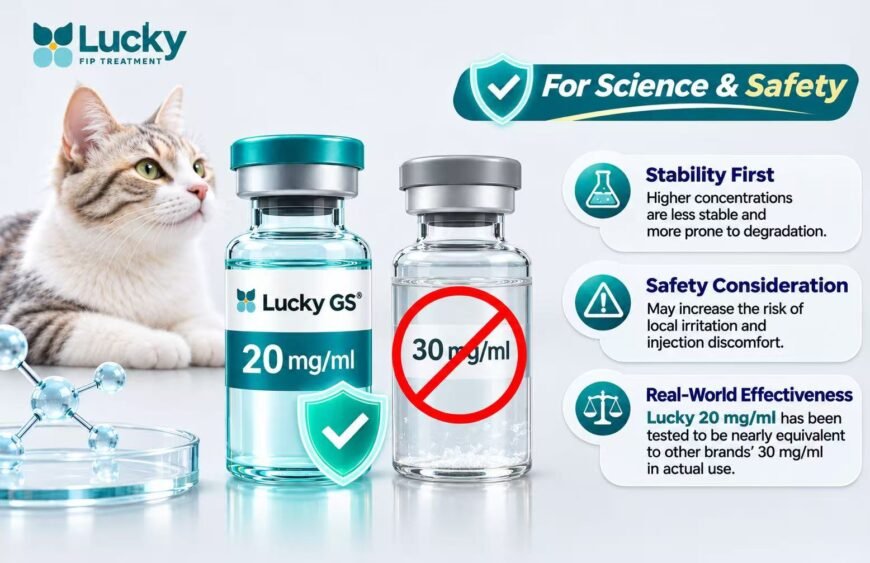
We are often asked by FIP caregivers and veterinary why our highest concentration is 20mg/ml instead of 30mg/ml like other brands. In short, For Science & Safety, not for Trick & Induce.
1. Lucky 20mg/ml Measured Close to Another Brand's Label 30mg/ml
In a publicly organized test of more than 30 black-market GS products (source), one brand's label 30mg/ml injection measured 29.1mg/ml. Lucky’s label 20mg/ml injection measured 28mg/ml, only 1.1mg/ml (about 3.7%) lower. As the picture below shows.
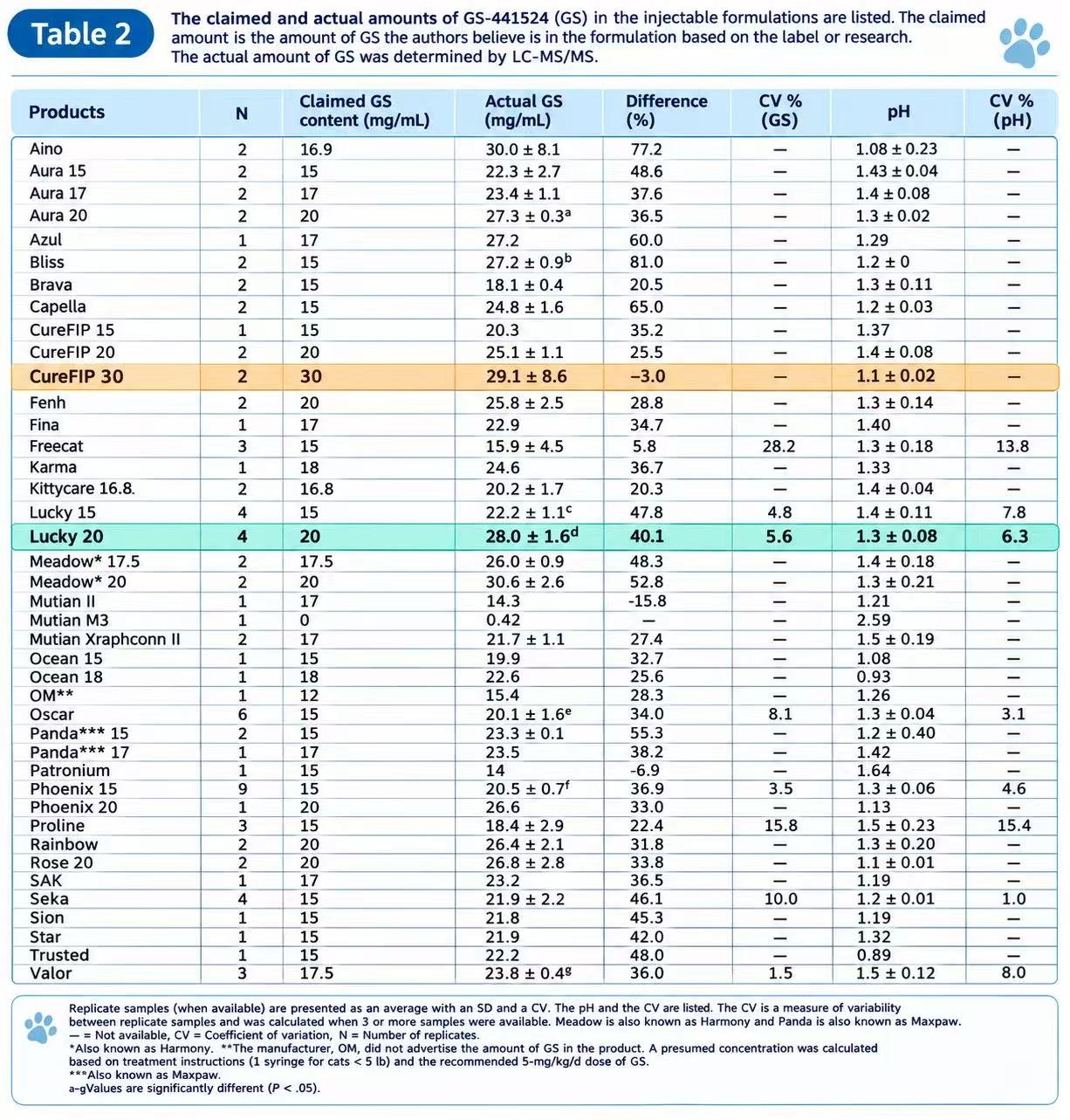
If we were to produce a fake 30mg/ml product whose actual tested value is lower than 30mg/ml and close to that of the existing Lucky 20mg/ml, we believe it would mislead caregivers. That goes against our scientific integrity and ethical standards.
To be clear, we are not claiming Lucky 20mg/ml is truly 28mg/ml. We believe the result was inflated by the testing method, though Lucky’s actual concentration is likely slightly above the label.
Some may question the accuracy of the test. All 30+ products were measured under the same conditions, and results generally read higher than labels. The 29.1mg/ml brand was probably overestimated in the same way, so the comparison remains meaningful.
2. Inter Experiment observes 30mg/ml Solubility limit
Solubility limit. Actually, we did an internal experiment in year 2023, GS was added incrementally to the solvent by our formulation technician. Dissolution became progressively more difficult with each addition, and precipitation occurred once the solution exceeded saturation. The saturation point was observed at approximately 26 mg/mL. On this basis, we consider a concentration of 25 mg/mL to be achievable, whereas 30 mg/mL appears unrealistic under the conditions tested.
Unfortunately, no video or written records of the experiment were retained, so these findings should be regarded as informal observations rather than validated data. We invite interested chemical researchers to repeat the experiment and report further observations. If reproducible evidence of successful dissolution at 30 mg/mL is available, we would be glad to learn from it.
The publicly test results mentioned in Part 1 above is also consistent with this view as the label-30mg/ml product measured below 30mg/ml. (source)
Question: We believe everyone would agree that if 30mg/ml is achievable, people at least need an independent, impartial third-party laboratory to verify a data of 30mg/ml or higher. Furthermore, the sample must be randomly drawn for testing without the vendor's prior knowledge, rather than being a specially prepared sample crafted by the vendor.
Furthermore, Forcing dissolution with acid is unlikely to solve the problem. Adding extra hydrochloric acid may dissolve more GS, but it introduces other risks:
- Supersaturation. A solution held above its natural solubility limit is thermodynamically unstable. Small disturbances, such as dust or a rough container surface, can trigger crystallization.
- Temperature sensitivity. Solubility usually drops as temperature falls. A solution that is clear at room temperature may crystallize during cold shipping, refrigeration, or overnight cooling.
- Common-ion effect. If GS is dissolved as a hydrochloride salt, extra chloride from added HCl may reduce its solubility, working against the goal.
- Crystals. Precipitate can clog needles and make dosing inconsistent. Once crystals form, the concentration of the remaining liquid changes, so the dose per ml becomes unreliable.
- Chemical stability. Strongly acidic conditions may accelerate degradation of the active ingredient and shorten shelf life.
- Injection comfort. Very low pH can cause pain at the injection site and may irritate a cat's skin.
- Batch variability. A formulation at the edge of solubility is more sensitive to small errors in weighing, temperature, and storage, which makes batch-to-batch consistency harder to maintain.
3. Solubility & Concentration in Dr. Pedersen’s Formulation Studies
GS-441524 has inherently limited aqueous solubility, particularly around physiological pH. The original published FIP treatment studies conducted by Dr Pedersen from UC Davis School of Veterinary therefore used specially formulated injectable solutions containing 10–15 mg/mL GS-441524 in a cosolvent system under strongly acidic conditions (source). Under the article’s science, Lucky developed 15 mg/ml in year 2019 and 20 mg/ml in year 2020.
Conclusion
Lucky 20mg/ml measured close to another brand's label 30mg/ml. Without evidence that 30mg/ml can be kept stable, we follow science, we are unwilling to compromise stability, consistency, and comfort for a higher number on the label. We believe a stable product with reliable concentration serves cats better.
In the future, we may develop 25mg/ml higher injection.
"We recognize that a higher concentration means a smaller injection volume, but we do not believe this convenience justifies the risk of under-dosing or skin pain in cats."
Practical Options for Cats Requiring High-Dose Injectable Treatment:
- Combine half injections and half oral tablets: Caregivers can use a combination of half injectable and half oral tablets to reduce the single-injection volume while maintaining the full daily dose.
- Split into two injections per day: Administrating injections twice daily (every 12 hours) can provide somewhat better therapeutic efficacy than a single injection every 24 hours.
References
- Kent M, Cook S, et al. Unlicensed antiviral products for feline infectious peritonitis: assessment of GS-441524 content and pH. J Feline Med Surg / Animals (PMC11983332). Available at: https://pmc.ncbi.nlm.nih.gov/articles/PMC11983332/
- Pedersen NC, Perron M, Bannasch M, et al. Efficacy and safety of the nucleoside analog GS-441524 for treatment of cats with naturally occurring feline infectious peritonitis. J Feline Med Surg. 2019;21(4):271-281. Available at: https://pmc.ncbi.nlm.nih.gov/articles/PMC6435921/